THE MURDLE GUIDE
Build the relationships in the case, then make the accusation that the evidence supports.
In this guide
Murdle at a glance
What is Murdle?
Murdle is G. T. Karber’s daily murder-mystery puzzle. Karber is also the creator of the Murdle book series. The browser case and the books are distinct ways to encounter its mysteries.[1][4]
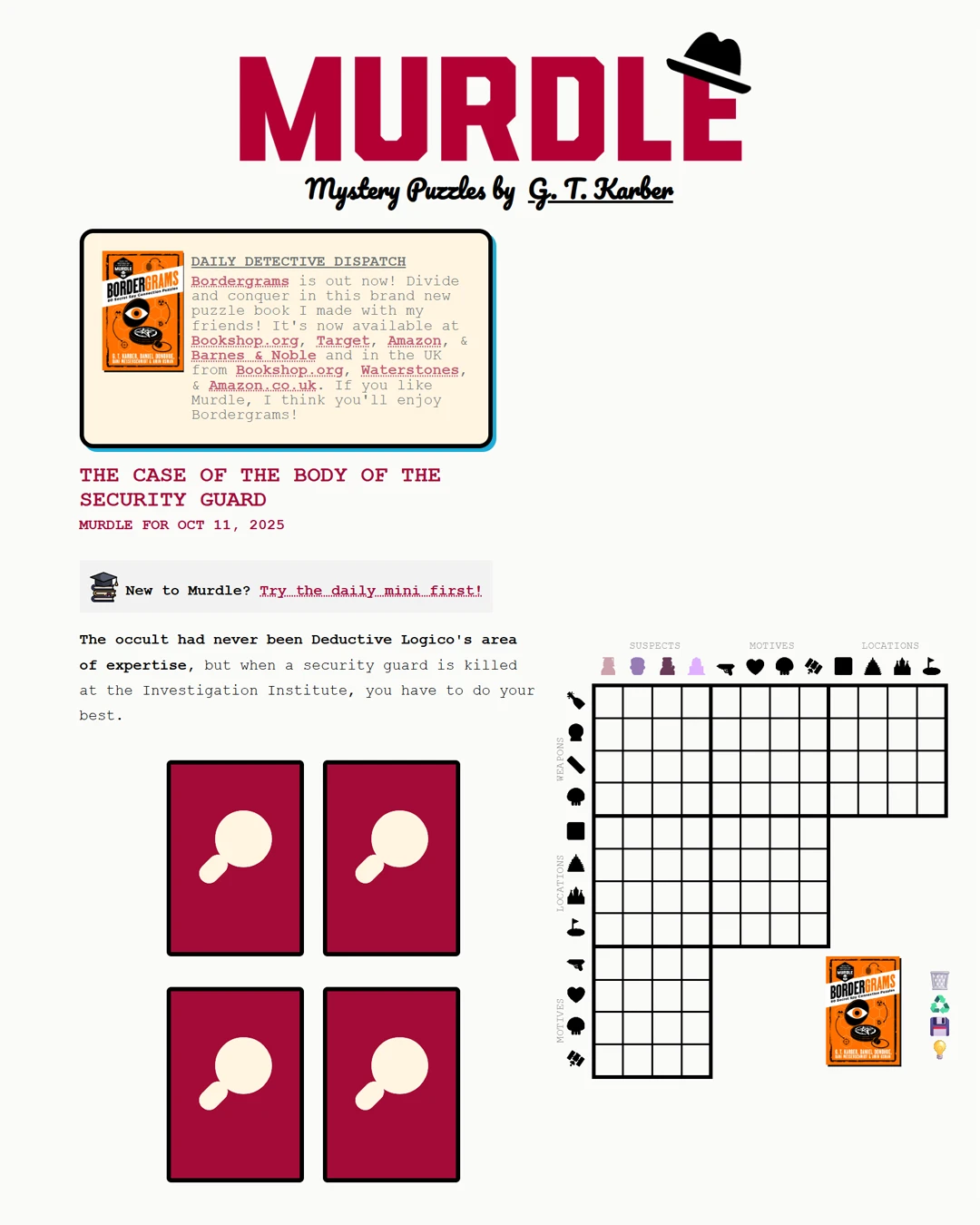
How to play Murdle with the deduction grid
Each suspect brings a weapon to a location. The official tutorial tells you to work out those relationships in the notebook, then use the red clue to identify the murderer. Submit your final accusation only when the required combination is established.[3][2]
Our recommended first pass is deliberately mechanical. Read every evidence line and record only direct matches or exclusions. Next, check any row or column with one possibility left. Finally, carry each confirmed relationship into the other relevant parts of the grid. This keeps a striking story detail from distracting you from a simple deduction.
An original Murdle-style deduction example
Imagine a miniature practice case with Ada, Ben and Cora, three different objects, and three rooms. If Ada has the lantern, neither Ben nor Cora has it. If the lantern is in the study, Ada is in the study. If Ben is not in the kitchen, and the study is already occupied, Ben must be in the remaining room. This is an invented teaching example, not today’s case.[3]
Notice the order: one positive relationship creates exclusions, and those exclusions create another positive relationship. Write the intermediate steps. If your next conclusion feels mysterious, it may be because you mentally skipped the grid mark that justifies it.
Read Murdle clues literally
The official tutorial warns that a relationship between two characters establishes that they are different people. On witness-statement days, the case explanation distinguishes truthful innocents from a lying culprit. Apply the rules shown in the current case rather than assuming every daily uses identical evidence.[2][3]
Our strategy is to separate three notes: established fact, exclusion, and temporary assumption. If you test a possible liar, label that branch clearly. A contradiction then tells you to reject the assumption without erasing deductions that were already certain. Avoid importing motives from detective fiction unless a clue explicitly supplies them.
Hints, difficulty and the daily case
The site offers an optional hint and states that puzzles can be solved without one. Its About text calls Saturday the hardest case and Sunday the biggest. The current daily generator uses the device’s local calendar date. Mini Murdle is linked from the official homepage.[2][1]
Before requesting help, try a focused review: find the least-used clue, check a nearly complete row, then reread any clue involving a weapon’s material or a room’s properties. If you still need a hint, use it as one additional fact and continue deriving the rest yourself.
Results and spoiler-free discussion
The official game tracks time and streaks and provides result-sharing logic.[2]
For a useful discussion with friends, compare how the case felt and where your reasoning stalled. Keep the culprit, weapon, location and any decisive clue concealed until everyone has submitted. A small private reasoning note is often more valuable for tomorrow than remembering only whether you won.
Murdle FAQ
Who created Murdle?
Writer and programmer G. T. Karber created Murdle and its book series.[4]
Do I have to use a hint?
No. The official tutorial says the puzzles can be solved through logical deduction without hints.[2]
Does every Murdle have the same format?
No. The current official game varies case size and can include motives or witness statements. Read that case’s instructions.[2][3]
Is Mini Murdle an official option?
Yes. The main site links to Mini through its tutorial-mode destination.[1]
Sources & verification
Checked · Daily Games editorial desk
- Murdle: official daily mystery game murdle.com
- Murdle: active official tutorial, About text and game logic murdle.com
- Murdle: active official case explanations murdle.com
- G. T. Karber: official author website gtkarber.com
Rules and access notes use the sources linked above. Examples and strategy suggestions are our editorial explanations, not guaranteed solutions. Original games can change. How we research guides.
Did this guide help?
Help us keep Murdle useful and accurate.