THE CONNECTIONS GUIDE
A tempting group of four is only part of the puzzle. The stronger test is whether your grouping leaves three other coherent groups behind.
In this guide
Connections at a glance
What is NYT Connections?
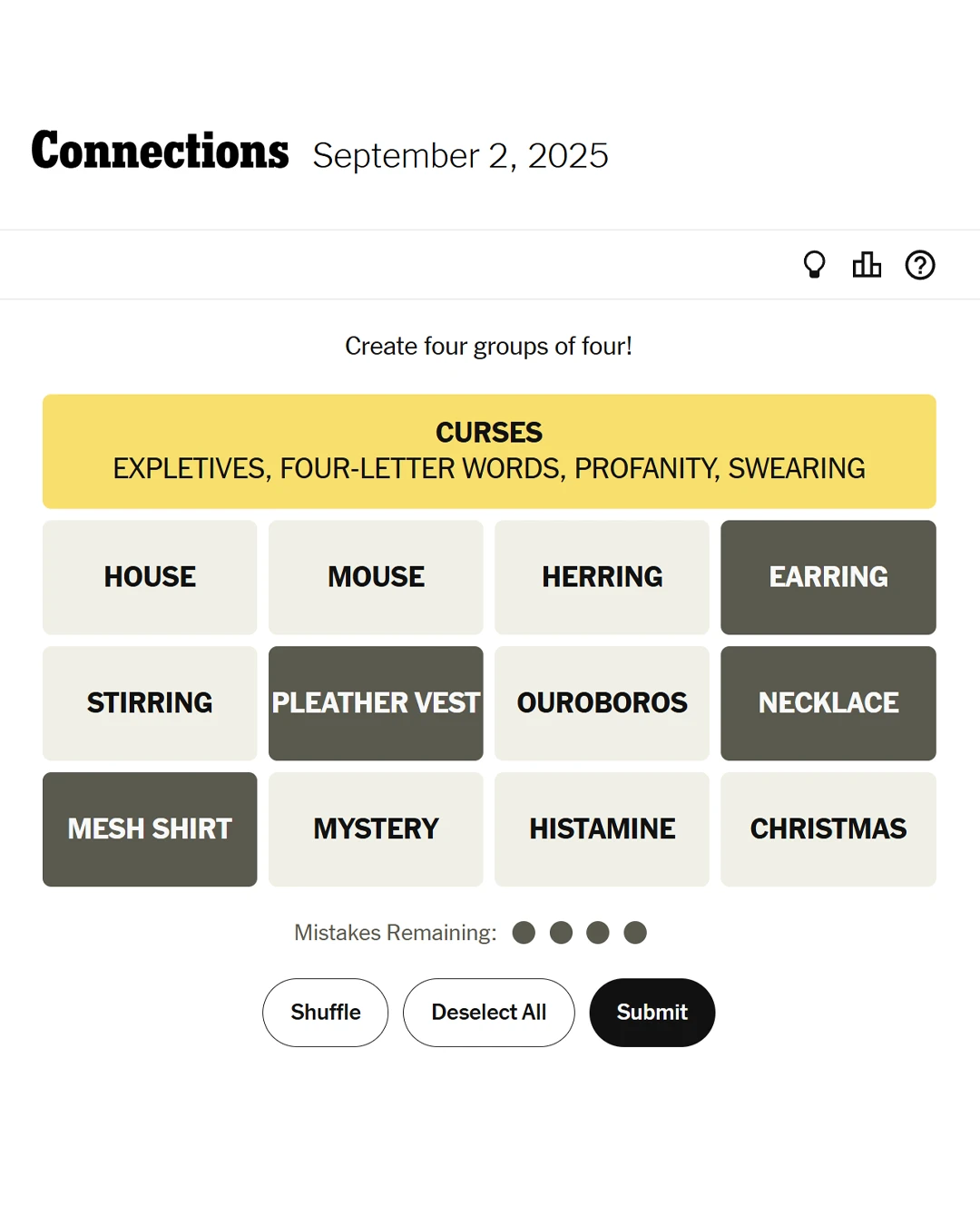
Connections is The New York Times’ daily grouping puzzle. You are given sixteen words or items and must partition them into four sets of four. Each set has a specific shared connection. The official explanation says each board has one intended solution, even though individual words may look plausible in more than one category.[1][2]
This is a grouping problem rather than a hidden-word problem. In Wordle, guesses expose information about one unknown sequence of letters. In Connections, all the pieces are visible from the beginning, but the relationships between them are concealed. A word’s less familiar meaning can matter as much as its most immediate one.[2][4]
How to play a round
Study the complete board, select four items that you believe form a category, and submit that set. Successful groups are removed from the remaining board. Incorrect submissions use the mistake allowance; the publisher’s statistics distinguish successful solves with fewer than four mistakes from attempts that reach four.[2]
Before submitting, describe the relationship precisely. “These feel related” is weaker than a phrase explaining how every item belongs. Then inspect the leftovers. If your proposed set strands another item that almost certainly belongs in the same category, you may have selected a plausible decoy rather than the intended four.[2]
An original example of the kind of connection
For a fictional wordplay group, BOW, COAT, DROP and FOREST can all follow RAIN to form familiar words. That is different from grouping the four by what their standalone meanings suggest. This invented example is not drawn from today’s board and does not imply that every difficult category uses a prefix or compound word.[2]
Another kind of false start is finding five plausible members of a simple category. Do not solve that by choosing an arbitrary four and hoping. Ask which member has a second meaning that could support another group, then test the complete partition again. The leftover structure is evidence, not a nuisance.[2]
What yellow, green, blue and purple mean
Solved groups are assigned yellow, green, blue or purple. The official Help Center describes yellow as the easiest category and purple as the trickiest, with the other colors between them. The color describes the category’s intended difficulty; it does not make a particular word permanently yellow or purple outside that puzzle.[2]
Do not force the board into a color theory before you have found the groups. A straightforward category may be the best starting point, but pursuing a specific color can distract from an obvious connection. Likewise, wordplay is worth considering when direct meanings fail, not something to assume mechanically about every purple group.[2]
Daily resets, progress and the archive
The current daily puzzle is free and releases at local midnight. The publisher recommends an account for keeping progress across devices. An eligible Games or All Access subscription provides the official archive; archived puzzles affect several overall statistics but do not extend the current daily streak.[2][3]
The official archive begins with June 12, 2023 puzzles and does not allow completed puzzles to be replayed. Treat the archive as a separate access feature from the free daily board. Connections Bot is another subscriber feature, while Sports Edition is a different game using the same basic grouping format.[2]
Connections FAQ
How many groups are in Connections?
Four groups of four items, drawn from sixteen items in total.[2]
What do the colors mean?
They represent intended category difficulty, from yellow as easiest to purple as trickiest.[2]
Is the daily game free?
Yes. The publisher says the daily Connections puzzle can be played without a subscription; its archive and analysis extras have different access requirements.[2][3]
Do archived puzzles count toward my streak?
No. The current Help Center says archive play affects several overall statistics but not current or maximum streaks.[2]
Sources & verification
Checked · Daily Games editorial desk
- Official NYT Connections game www.nytimes.com
- New York Times Help Center: Connections thenewyorktimeshelpcenter.helpjuice.com
- Official NYT Games subscription and free access thenewyorktimeshelpcenter.helpjuice.com
- Official Wordle rules for comparison thenewyorktimeshelpcenter.helpjuice.com
Rules and access notes use the sources linked above. Examples and strategy suggestions are our editorial explanations, not guaranteed solutions. Original games can change. How we research guides.
Did this guide help?
Help us keep Connections useful and accurate.