 Magnitudle




THE MAGNITUDLE GUIDE
One real-world question, one estimate. Use a little reasoning to find the right scale, then compare your answer with the explanation and other players.
In this guide
Magnitudle at a glance
What is Magnitudle?
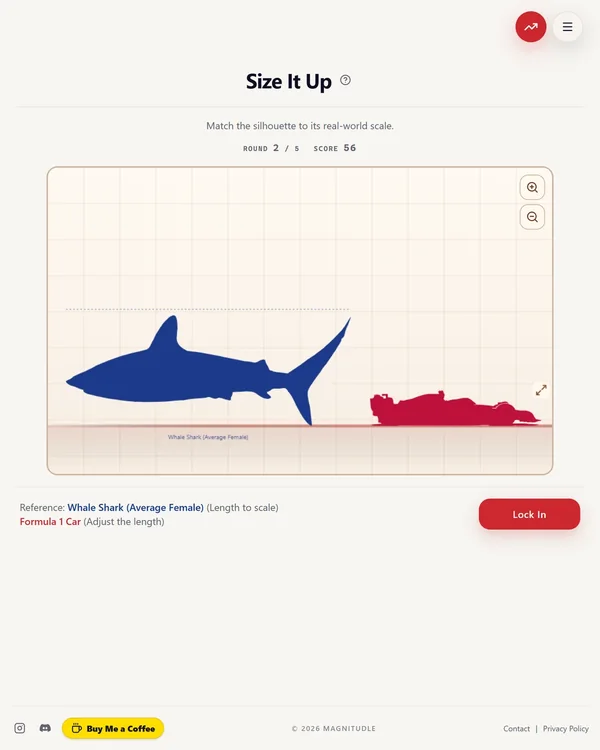
Magnitudle is an independent family of estimation games created by Teej and published through GriddleLink Games. This page starts the Daily Question: a real-world numerical prompt with one submitted guess each day. The publisher’s homepage also contains Size It Up and other challenges. The Daily Question is the numerical-estimation game, while Size It Up asks you to resize a silhouette beside a reference object.[3][2]
You do not need specialist knowledge to begin. The task is to reason toward a plausible number, commit to it, and learn from the revealed answer. The official Daily Question description says the result includes the answer, score and explanation. That makes the reveal useful even when your estimate misses: it shows what scale the question actually lives on.[3][2]
How the Daily Question works
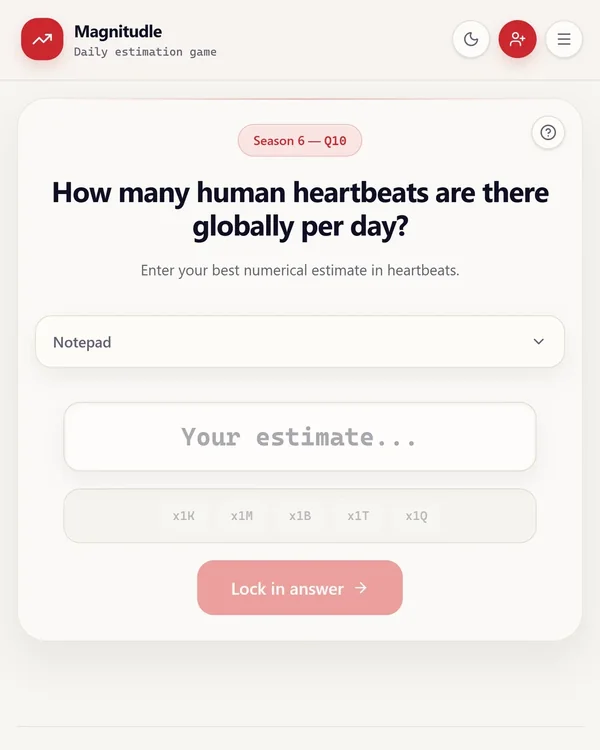
Read the complete prompt and its requested unit before calculating. Your final submission is the one daily estimate, so treat any scratch work as preparation rather than a series of guesses. The current game includes a calculation notepad with an expression input. Use it to preserve assumptions and arithmetic, then check that the number you submit answers the question rather than an intermediate step.[1]
For example, a question asking for a yearly total might require a daily estimate multiplied by days per year. Write those units beside the factors so that you do not stop at the daily figure. This is an invented estimation method, not a hint about today’s prompt. The best preparation is to make the structure of your estimate visible before you worry about the final digits.
How Magnitudle scoring works
The current Daily Question scoring measures multiplicative error: how many times your estimate is away from the answer. An exact or near-exact estimate receives 100 points. The official examples give 80 points for an estimate two times away and 42 for one ten times away. Equivalent overestimates and underestimates score equally. The game rewards finding the scale, with better precision earning a stronger result.[2]
That symmetry matters. Being twice the answer and being half the answer are the same proportional miss, even though their raw numerical differences are different. Use that idea when checking whether your estimate belongs in thousands, millions or billions. Correcting an order-of-magnitude mistake is often more useful than adjusting the last few digits of a number with the wrong scale.[2]
After an official game, the results include a grouped score graph and your rank out of the players who completed that puzzle. Ties share a rank and the ranking can change as the field changes. Compare the same game and puzzle; a score from Size It Up or a separate historical Daily Question is not the same competitive result.[2]
A practical strategy for large-number estimates
Break an unfamiliar total into two or three quantities you can picture. A population-style question might be approached as groups multiplied by the average amount in each group. A physical comparison might start with a familiar object and a ratio. Prefer a short chain of defensible assumptions to a long calculation built on numbers you do not trust.
Make a rough lower and upper bound. Ask what would have to be true for the answer to be ten times smaller or larger. If either extreme seems implausible, you have learned something before submitting. Then choose a central estimate and do a final unit check. Keep the assumptions after the reveal so you can identify which one contributed most to the miss.
Daily reset, archive practice and streaks
New daily games become available at midnight in your game timezone. A Daily Question streak increases when you submit the current question on consecutive game days. The Archive contains previous questions for practice, but archive submissions do not affect official streaks, statistics, leaderboards or badges. More practice and the official daily attempt therefore serve different purposes.[2]
Archived questions retain the scoring rules that applied when they were originally published. The publisher has changed scoring curves, while keeping previous results and personal bests intact. If an older question’s score differs from what the current examples suggest, check its historical context before treating that as a calculation error.[2]
Magnitudle FAQ
Is Magnitudle the same game as Size It Up?
Magnitudle is the game family. Its Daily Question is one numerical estimate; Size It Up is a separate five-round visual size-comparison game.[3][2]
Do overestimates score worse than underestimates?
Not when the proportional error is equivalent. The current Daily Question gives the same score to estimates twice and half the true answer.[2]
Can I play old Magnitudle Daily Questions?
Yes. The Archive offers previous questions as practice. Those attempts do not affect official daily streaks, statistics, leaderboards or badges.[2]
Do I need an account for Magnitudle?
No. Guest play is available. An account supports progress across devices, while guest progress is stored in the current browser.[2]
Sources & verification
Checked · Daily Games editorial desk
- Magnitudle — official Daily Question game magnitudle.com
- Magnitudle — official rules, scoring, accounts and archive FAQ magnitudle.com
- Magnitudle — current game family and creator information magnitudle.com
Rules and access notes use the sources linked above. Examples and strategy suggestions are our editorial explanations, not guaranteed solutions. Original games can change. How we research guides.
Did this guide help?
Help us keep Magnitudle useful and accurate.