THE COSTCODLE GUIDE
Start with a shopping estimate, then turn the arrows into a narrower price range.
In this guide
Costcodle at a glance
What is Costcodle?
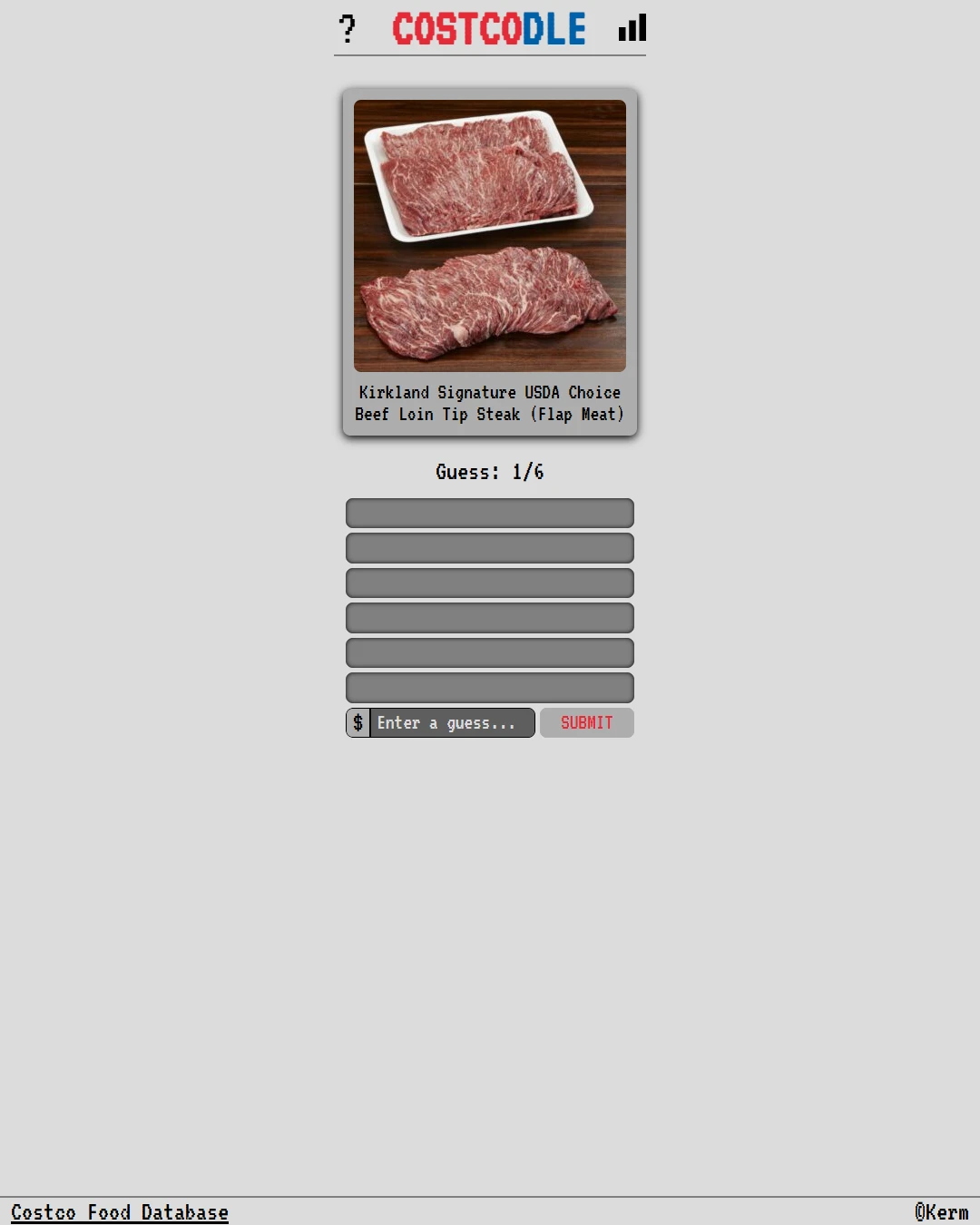
Costcodle is a daily price puzzle about Costco food products. Its creator’s GitHub project acknowledges Wordle and Tradle as inspirations and links to the official play destination, costcodle.com.[2]
The appeal is the change from recognition to estimation. You may recognize a product immediately and still be unsure what the whole package should cost. Our view is that the interesting part begins when your first shopping intuition meets the game’s numerical feedback.
How to play Costcodle
Inspect the product name, image and package information, enter a valid dollar price, and submit. There are six attempts. A guess within 5% of the target wins; an incorrect one gives directional feedback to guide the next estimate.[1][3]
Our opening routine is to identify exactly what is being priced. Separate one bottle from a case, one item from a multipack, and a small package from a bulk quantity. Make a reasonable total-package estimate before thinking about cents. This is a strategy suggestion, not a rule about how any particular warehouse prices its stock.
Costcodle arrows and the 25% feedback band
An upward arrow means the target is higher than your guess; a downward arrow means it is lower. The game also separates misses within 25% from more distant misses. A check mark indicates a winning guess. These clues describe distance from the puzzle’s target price.[1][3]
Suppose a fictional product’s target is $40. A $30 guess is 25% low; $38 is 5% low and reaches the winning margin. Those values are invented to explain the percentages. The important distinction is that the tolerance is a proportion of the target, not a fixed number of dollars.[3]
Costcodle strategy: maintain a bracket
Our advice is to remember your best lower and upper bounds. If $12 is too low and $24 is too high, a middle estimate such as $18 tests a useful part of the remaining interval. Repeating $13, $14 and $15 uses attempts without exploring the range as efficiently.
Once a guess is close, reduce the size of your changes. A near miss is evidence that your general scale was reasonable. Keep the arrow’s direction in view: a smaller correction in the wrong direction still contradicts the information you have already earned.
Avoid letting a familiar price ending dominate the entire decision. Estimating the correct magnitude and reading the feedback will usually give you more useful information than insisting that the answer must end in a particular pair of digits. Treat remembered shopping prices as starting hypotheses.
Daily puzzles, statistics and sharing
The official rules promise a new Costcodle each day. The statistics panel lists games played, win percentage, current and maximum streaks, and guess distribution. The official code creates a Share button after a round and stores progress in the browser.[1][3]
Share the compact result rather than a screenshot that exposes the product or exact target. If comparing attempts with friends, agree whether looking up prices is allowed before starting. Keeping the same convention makes a six-attempt comparison more meaningful.
What the displayed price means
The project acknowledges the Costco Food Database, but its rules do not explain a universal current warehouse, tax or regional pricing basis. Use the displayed number as the puzzle’s target; this guide does not treat it as a live shopping quote.[2][3]
For reviewing a miss, ask whether your error came from quantity, product type or feedback interpretation. That turns an unfamiliar item into an estimation lesson without assuming that the revealed amount will match a future purchase.
Costcodle FAQ
Do I need the exact Costcodle price?
No. Any valid guess within 5% of the target is a win.[1]
How many guesses do I get?
Six attempts for the daily item.[1]
What does an up arrow mean?
The target price is higher than your guess. A down arrow means it is lower.[1]
Is there an official unlimited mode?
The official rules describe one new puzzle each day. No unlimited mode is established by the official sources checked here.[1]
Sources & verification
Checked · Daily Games editorial desk
- Costcodle: official rules and examples costcodle.com
- Costcodle: creator’s project and README github.com
- Costcodle: official feedback, product and sharing logic costcodle.com
Rules and access notes use the sources linked above. Examples and strategy suggestions are our editorial explanations, not guaranteed solutions. Original games can change. How we research guides.
Did this guide help?
Help us keep Costcodle useful and accurate.