THE SIZE IT UP GUIDE
A known reference and an unfamiliar silhouette turn everyday size knowledge into five visual comparisons.
In this guide
Size It Up at a glance
What is Size It Up?
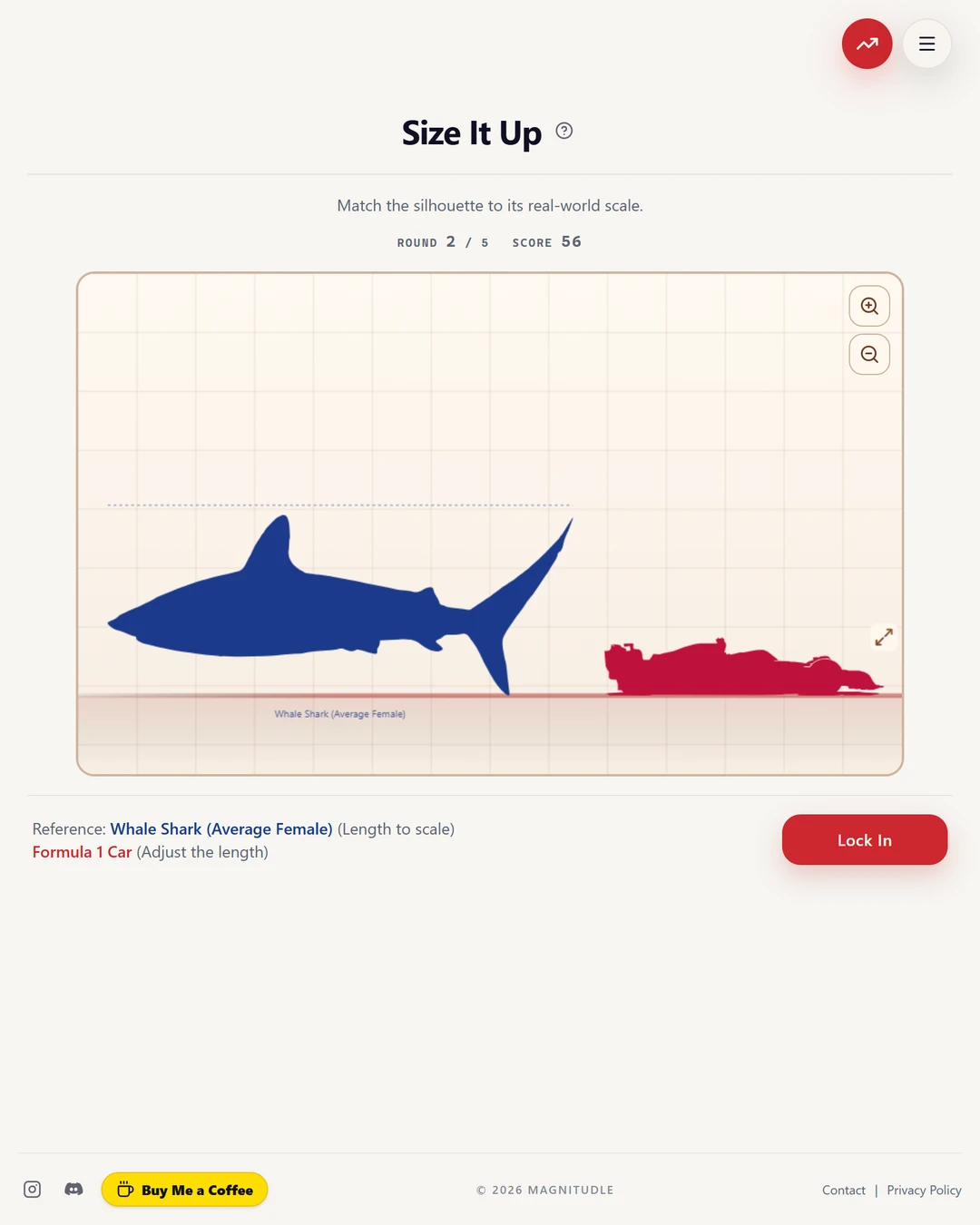
Size It Up is Magnitudle’s daily visual scale-estimation game. You resize a target silhouette beside an object supplied as a reference, then submit the size you believe is correct. The original site calls for five comparisons and awards up to 100 points for each, producing a maximum total of 500.[1]
This is a game of relative size, not a request to recite an exact measurement. Our suggestion is to treat the reference as a measuring stick: decide whether the target should be a fraction of it, roughly comparable, or several times larger before making a fine adjustment.
How to use the reference effectively
Playlin’s reviewed walkthrough describes adjusting the mystery shape, zooming when needed, and locking in each estimate before moving through the five rounds. The useful distinction is between looking more closely at the comparison and changing your estimate of the object’s actual scale.[5]
Choose a consistent dimension to compare. If one silhouette is long and low while the reference is tall and narrow, comparing their total screen area can be misleading. Make an explicit judgment about the relevant height, length or extent shown, rather than treating the silhouette’s visual bulk as a measurement.
For a made-up practice comparison, suppose you believe the target is about three reference lengths long. First place it near that ratio; only then consider whether it should be a little shorter or longer. This staged approach gives each adjustment a reason and reduces last-second wobbling between very different scales.
What the 500-point total tells you
The official FAQ says that closer estimates earn more points. It does not publish a scoring formula on the page we checked. Treat 500 as the five-round ceiling, not as evidence that a particular percentage error always loses a fixed number of points.[1]
Review the kind of miss as well as its size. Repeated overestimates may suggest that you are relying on how imposing a subject looks; repeated underestimates may suggest an unfamiliar reference. Those are editorial prompts for learning from the reveal, not diagnoses built into the game.
A lower-scoring round can still be useful if it corrects a scale relationship you will remember. Before the next comparison, briefly restate that relationship to yourself. This makes the daily set a sequence of concrete calibrations rather than five unrelated surprises.
Original, Pop Culture and Geography
Pop Culture edition
The Pop Culture edition applies the same estimation format to recognizable characters. Its publisher explicitly separates the game from the rights holders of the characters and brands it depicts. Familiarity with a character is not the same as knowing its intended scale.[2]
Geography edition
The Geography edition uses places and geographic shapes, including countries, states, lakes, cities and natural wonders. It still asks for resizing relative to a known reference; it is not a country-name guessing game.[3]
The official archive
The original page links to a Size It Up archive, with its filter set to the regular edition. That confirms an official route to older games, although the text-only archive response did not establish current access requirements for every past set.[4][1]
Size It Up FAQ
How is Size It Up scored?
There are five rounds, worth up to 100 points each, for a maximum total of 500. Closer estimates score better.[1]
Is Geography a different game mechanic?
It uses the resizing format with geographic subjects rather than ordinary objects or characters.[3]
Are there older Size It Up games?
The official game links to an archive filtered to Size It Up. Current archive conditions should be checked on that page.[4]
Sources & verification
Checked · Daily Games editorial desk
- Magnitudle — Size It Up rules and FAQ magnitudle.com
- Size It Up: Pop Culture magnitudle.com
- Size It Up: Geography magnitudle.com
- Magnitudle archive filtered to Size It Up magnitudle.com
- Playlin’s reviewed Size It Up guide playlin.io
Rules and access notes use the sources linked above. Examples and strategy suggestions are our editorial explanations, not guaranteed solutions. Original games can change. How we research guides.
Did this guide help?
Help us keep Size It Up useful and accurate.