THE POOPLE GUIDE
One letter changes on each move, every intermediate entry must be a word, and the destination stays the same.
In this guide
Poople at a glance
How to play the daily Poople word game
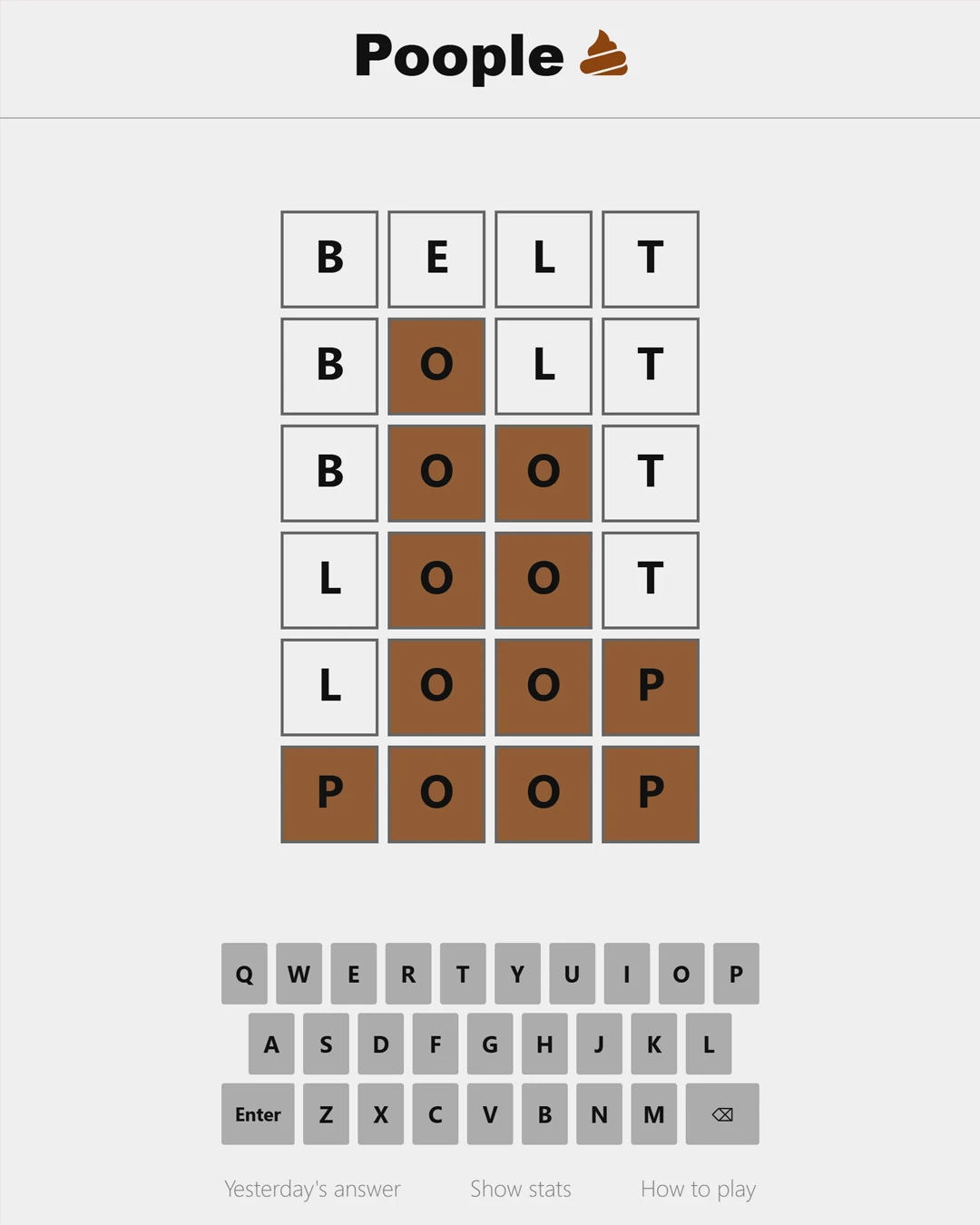
Poople gives you a new starting word each day and asks you to reach POOP. Its official how-to requires each successive word to differ by exactly one letter; the aim is to use as few steps as possible.[1]
The reviewed rules clarify that the intermediate entries must be real English words. You cannot add, remove or rearrange letters to make a transition. This makes the puzzle a route through four-letter vocabulary, rather than an anagram or a search for an unknown target.[2]
Our suggested opening move is a pause: identify which positions differ from POOP and list a few legal neighbors of the starting word. A word that looks closer to the destination may have poor onward options, while a less obvious change can create the bridge you need.
An original example of a legal ladder
For illustration, POLL → POOL → POOP changes one letter on each move. The first transition changes the third letter, and the second changes the fourth. It demonstrates the rule without using a live daily start or giving away a published puzzle’s solution.
Now contrast that with jumping directly from POLL to POOP: two positions differ, so it cannot be one move. Checking transitions this way is a useful habit when a route exists clearly in your head but the game rejects the next entry.
Letter distance is a useful lower bound, not a complete solving method. Every differing position needs a change eventually, but the chain still has to travel through valid words. A direct-looking sequence can fail because one of its imagined intermediate strings is not a word.
Plan bridges instead of collecting random words
Our editorial approach is to search from both ends. List a few candidate moves from the start, then consider the kinds of words that could sit just before the target. You are looking for a meeting point between the two small searches, not trying to memorize an enormous vocabulary list.
Keep an alternative branch available before committing to a long chain. If the next move only leads back to a word you already used, return mentally to the last useful decision. Repeating near-identical guesses is unlikely to reveal a different connection unless you change the position or word family you are testing.
After finishing, inspect one inefficient stretch of your route. Did you replace a letter twice because you could not see a bridge? Did you overlook a familiar word with a different meaning? Those are concrete lessons you can carry forward without keeping an answer sheet beside the daily puzzle.
The family-game idea and the Feetle connection
Poople’s original help describes the idea as a family road-trip game. Playlin credits Elias Furst, and Feetle’s own About page acknowledges his Poople as its inspiration.[1][2][3]
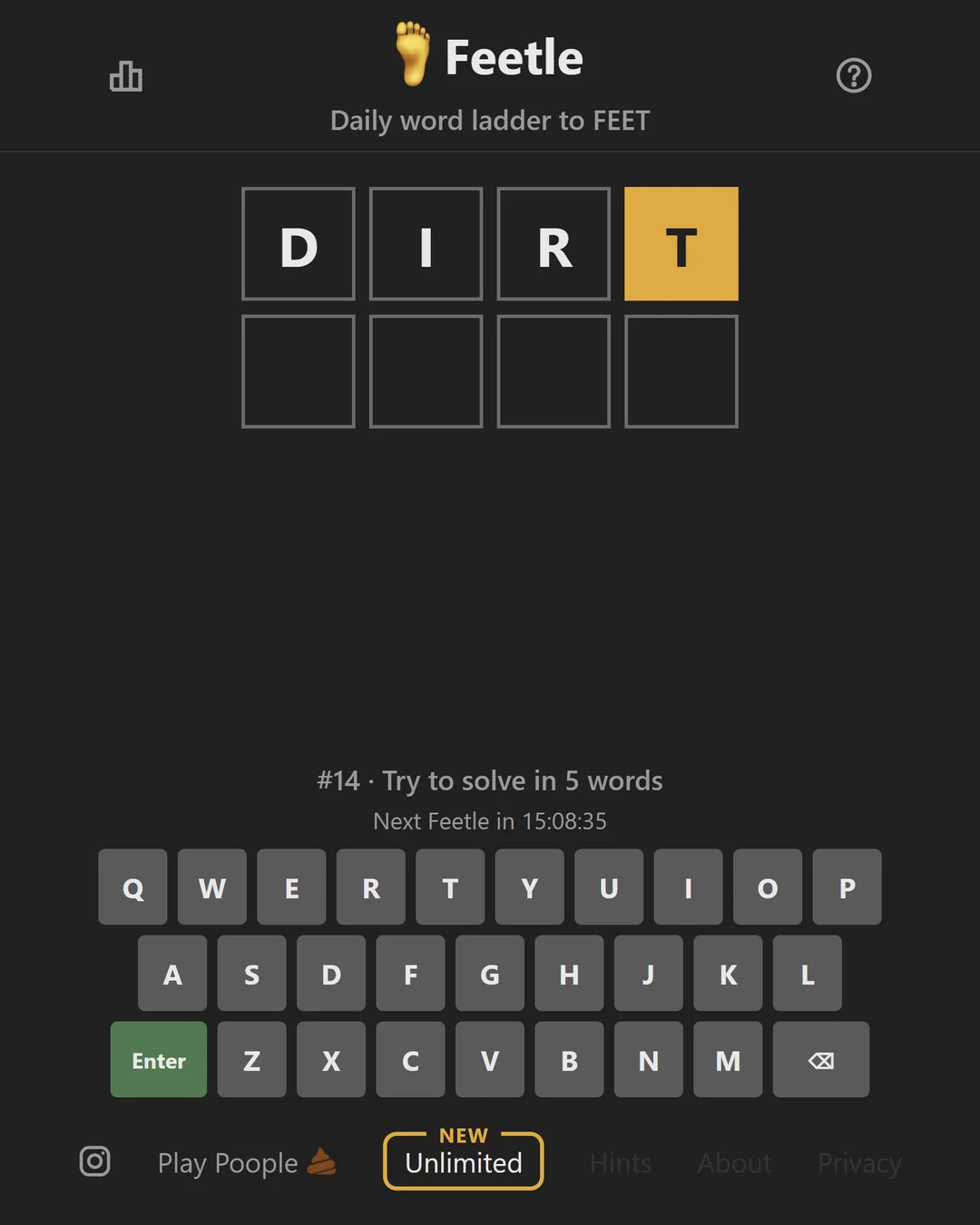
Feetle changes the fixed destination to FEET while keeping the one-letter ladder concept. Switching targets changes the final bridge words you must consider, so it is a related alternative rather than simply another copy of the same daily route.[4]
If you enjoy Poople because you can see the destination but not the path, try a related ladder before moving to a hidden-answer game. If you want a different kind of reasoning, choose a word puzzle whose feedback tells you about an unknown answer. That distinction is an editorial way to choose your next game.
Compare move counts without posting the route
A move count and puzzle date let another player compare results without revealing the bridge words. Keep your chain out of the first message, especially when the shortest route is very short. If you give a hint, offer one useful direction or a letter position rather than the entire next word.
Poople FAQ
Is the target always POOP?
Yes. The original how-to uses POOP as the destination while the starting word changes daily.[1]
Can I change the order of the letters?
No. The reviewed rules require changing exactly one letter in place, without adding, removing or rearranging letters.[2]
Sources & verification
Checked · Daily Games editorial desk
- Poople original game and published how-to-play poople.io
- Playlin’s reviewed Poople rules and creator credit playlin.io
- Feetle official About page crediting Elias Furst’s Poople feetle.fun
- Feetle official game for the target-word comparison feetle.fun
Rules and access notes use the sources linked above. Examples and strategy suggestions are our editorial explanations, not guaranteed solutions. Original games can change. How we research guides.
Did this guide help?
Help us keep Poople useful and accurate.