THE NYT PIPS GUIDE
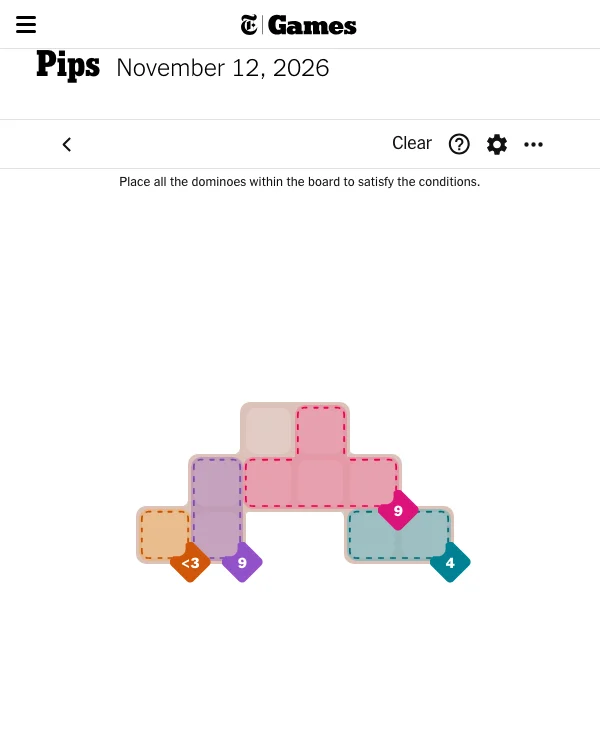
Place dominoes to fill the grid. Each colored region adds a condition that your placements must satisfy together.
In this guide
NYT Pips at a glance
What is the NYT Pips game?
Pips is a domino placement puzzle from The New York Times Games. Each domino covers two touching squares, while colored regions may cover a different group of squares. The objective is to fill the board so every region’s condition works at the same time. New Easy, Medium and Hard puzzles are offered each day.[1][2]
Heidi Erwin led the game design. Her account of the early prototypes explains why an individual region is not confirmed as you play. A piece can satisfy a local rule and still make the rest of the board impossible. Pieces remain movable as you work toward a complete solution.[4]
What each Pips region symbol means
A region’s tag describes the dots on the squares inside that region. A single domino can contribute one end to one region and its other end to another. Read both ends before you place it. Traditional domino matching across touching ends is not the objective.[2][4]
A useful habit is to count the region’s squares first, then translate its tag into possibilities. For a fictional two-square region marked 3, possible totals include 0 plus 3 or 1 plus 2. Then check whether those halves exist on the dominoes you still have and whether each fits the board geometry.
| Tag | What the region needs |
|---|---|
| Number | The dots in the region add up to that number. |
| = | Every square in the region has the same number of dots. |
| ≠ | Each square has a different number of dots. |
| > | The region’s total is greater than the number shown. |
| < | The region’s total is less than the number shown. |
| No tag | The region adds no dot condition. Its squares still need to be filled. |
Spoiler-free Pips hints for today’s board
First look for a square with only one available neighboring square. The direction of its domino is forced even when the values are still unknown. Then look for tight conditions such as a total of zero, a low strict inequality, or a row of identical values. Combine shape and number restrictions before choosing a tile.
Try both orientations before ruling out a piece. A 0–4 can put its zero in a low-total region and its four outside it. If you rotate it the other way, both regions might still appear to work for now, but a later region may need the zero. Check which unused tiles a tentative placement leaves behind.
When you get stuck, revisit the last placement you chose without a firm reason. Reopening one uncertain decision is easier than starting the whole puzzle over. An unmarked region gives you flexibility, so fill it when the neighboring conditions tell you what belongs there.
Which Pips difficulty should you choose?
The official game offers Easy, Medium and Hard from the daily selector. Start with Easy to learn how tags and domino shapes interact. Use Medium when you can track several regions at once, and Hard when you want to work through more competing placements.[1][2]
The game lets you keep moving tiles until the board is correct. A cookie marks a solve under the target time for its difficulty, and the Cookie Trifecta is earning one on each daily board. The timer can be turned off in settings if you prefer to solve at your own pace.[2]
When Pips resets and where to play
The original is available through the NYT Games website and mobile apps. The Help Center says new puzzles arrive at midnight in the player’s local time. Pips is listed among the daily games available without a Games subscription. The official page offers sharing after a completed board.[2][3]
Open the publisher’s date and difficulty selector for today’s original puzzle. To practice a technique before seeing the daily board, use the invented examples above. Those examples do not reveal the current solution.
NYT Pips FAQ
How do you win NYT Pips?
Fill every square using the provided dominoes and meet all of the colored regions’ conditions at once.[2]
What is a cookie in Pips?
A cookie is awarded for finishing a board under its difficulty’s target time. Earn one on Easy, Medium and Hard for a Cookie Trifecta.[2]
Does Pips have a move limit?
No. The official rules let you rearrange tiles and keep trying until the board is solved.[2]
When do the NYT Pips boards reset?
The three daily puzzles are published at midnight in your local time.[2]
Is NYT Pips free?
The New York Times lists Pips among its daily games available without a Games subscription.[3]
Sources & verification
Checked · Daily Games editorial desk
- Original NYT Pips and difficulty selection www.nytimes.com
- The New York Times Help Center: Pips rules, access and daily reset thenewyorktimeshelpcenter.helpjuice.com
- NYT Games access and subscription guide thenewyorktimeshelpcenter.helpjuice.com
- Pips lead designer Heidi Erwin on the game’s development and feedback heidierwin.com
Rules and access notes use the sources linked above. Examples and strategy suggestions are our editorial explanations, not guaranteed solutions. Original games can change. How we research guides.
Did this guide help?
Help us keep NYT Pips useful and accurate.