THE AMOUNTLE GUIDE
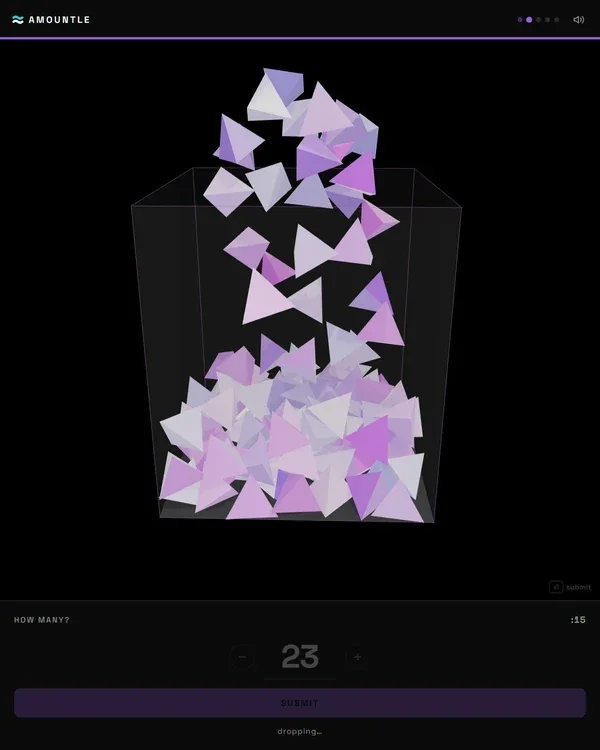
Watch the objects fall, turn the container and submit your estimate. Five short rounds put your sense of quantity to the test.
In this guide
Amountle at a glance
What is Amountle?
Amountle is a visual estimation game made by Isaac Audet. Objects drop into a container, and you guess how many there are. Everyone receives the same five daily rounds. After each estimate, the objects count up to reveal the total, making it easy to compare the number you imagined with the actual pile.[3]
The challenge is closer to estimating a full jar than solving a calculation from written clues. You need to read shape, depth and packing quickly. A useful session can be short: make five considered estimates, inspect where you tended to guess high or low, and come back with one adjustment for the next daily set.
How to play Amountle: the current daily rules
Watch the whole drop, then drag to rotate the container for another view. Enter one estimate using typing or the on-screen number pad and submit within fifteen seconds. The answer is revealed through a count-up, and the next round begins automatically. A short tutorial introduces the controls.[2]
Do not use the first front-facing layer as though it were the whole container. Rotate with a purpose: check depth, empty spaces or a partly hidden layer, then settle on an estimate. A second view is most useful when it answers one specific uncertainty instead of encouraging endless adjustments.
Submit a number you can explain
Choose a rough model before fine-tuning. You might estimate a visible cluster and consider how many similar clusters fill the volume. On another shape, counting a small number of layers may be more useful. These are estimation techniques, not promises that every pile is evenly packed.
Amountle scoring and the exact-answer bonus
Closer estimates earn more points, with up to 100 base points per round. The current rules add a bonus for an exact estimate equal to one third of the object count, rounded to the nearest whole point. Five rounds therefore have 500 available base points, but 500 is not a total ceiling once exact-answer bonuses are included.[2]
Read the round breakdown before judging only the overall total. A very close estimate on a large pile and an exact result on a smaller one can contribute differently. When comparing with a friend, use the same daily set and distinguish the displayed score from a claim that you counted every object individually.
Track the direction of your error as well as its size. Repeatedly guessing low can suggest that hidden depth is being underestimated; repeatedly guessing high may mean you are treating empty gaps as occupied space. Use the reveal to check that hypothesis rather than automatically adding a fixed percentage next time.
A practical Amountle estimation strategy
Observe the pour rather than waiting for the final pile alone. A few recognizable groups can anchor the estimate, while the final view helps you account for stacking. For irregular shapes, pause your mental count at a known cluster and compare that cluster with the remainder instead of trying to follow every collision.
Give yourself time to enter the number. The best estimate you never submit cannot help the round. Once you have a defensible range, choose a value and commit, especially when a last rotation is unlikely to resolve the remaining uncertainty.
Use untimed practice to experiment with a method: cluster counting on one session, layers on another. Review which shapes caused the method to fail. Daily play then becomes a chance to choose the appropriate approach rather than to repeat one rule for every container.
Practice, Fill, Survival and past puzzles
Practice has five rounds without a timer and does not change the Daily score. Other official formats include Fill, where you pour toward a target count; Survival, where close estimates keep the run going; and Over / Under, where you judge whether a total is above or below a shown number.[3][2]
The daily game remains free. Amountle+ is an optional one-time purchase that includes the complete Daily archive and other account-linked benefits. It is not required for the current daily puzzle. Check the publisher’s current offer and purchase terms rather than assuming every archive entry is free.[4]
Choose Practice for a calmer session, a short alternate mode for variety, or Daily for an identical set to compare with friends. Keep those results separate; an untimed practice success is useful training but is not today’s timed leaderboard result.
Amountle FAQ
How many rounds are in daily Amountle?
The original daily game has five rounds, with the same piles for everyone.[2]
How long do I have to guess?
The current official rules give fifteen seconds per estimate. Older directory descriptions using eight seconds are out of date.[2]
Is 500 the highest Amountle score?
No. Five rounds offer 500 base points, and exact guesses add a bonus equal to one third of the object count, rounded to the nearest whole point.[2]
Can I play Amountle without a timer?
Yes. Practice has five untimed rounds and does not change your Daily score.[2]
Who created Amountle?
The official About page credits Isaac Audet.[3]
Is Amountle free?
The daily game is free. Complete archive access and other extras are offered through the optional one-time Amountle+ purchase.[4]
Sources & verification
Checked · Daily Games editorial desk
- Amountle — official game and current modes www.amountle.dev
- How to Play Amountle — current rules and scoring www.amountle.dev
- About Amountle — creator and game formats www.amountle.dev
- Amountle terms — free daily play and optional archive purchase www.amountle.dev
Rules and access notes use the sources linked above. Examples and strategy suggestions are our editorial explanations, not guaranteed solutions. Original games can change. How we research guides.
Did this guide help?
Help us keep Amountle useful and accurate.