THE TRAVLE GUIDE
Connect two places by naming the countries between them. The challenge is a continuous journey, with a shorter route and fewer wasted guesses as your goal.
In this guide
Travle at a glance
What is Travle?
Travle is a geography puzzle about finding a connected route from a named start to a named destination. You submit countries or regions that a journey can pass through. It is not a distance-guessing game: a country can be geographically close to the destination yet fail to connect the route you have built. The official information page identifies Oisín Carroll as its creator and Travle as a Teuteuf game.[2]
The main puzzle gives a finite allowance rather than unlimited attempts. That allowance changes with the shortest possible solution. For example, the official table gives five extra guesses when the shortest solution requires four to six guesses. A route requiring six guesses therefore allows eleven total. Read the allowance for the puzzle in front of you instead of assuming every daily geography game uses six attempts.[2]
Which borders and connections count in Travle?
Think of a continuous journey, not a checklist of countries that have ever shared a border. Travle includes adjacent areas and connections through bridges or tunnels. Its examples include the Channel Tunnel between France and the United Kingdom and the bridge-and-tunnel connection between Denmark and Sweden. The game also permits limited movement over water between separated parts of the same country when there is no other connecting route.[2]
Exclaves do not create a shortcut through the rest of their country. Kaliningrad does not make mainland Russia a direct route from Poland; Spain does not connect to Morocco through its North African exclaves. Some territories are also treated separately. These are rules of the puzzle map, so the official connection explanation is a better reference than an ordinary political map when a familiar route seems to fail.[2]
How to read green, orange and red guesses
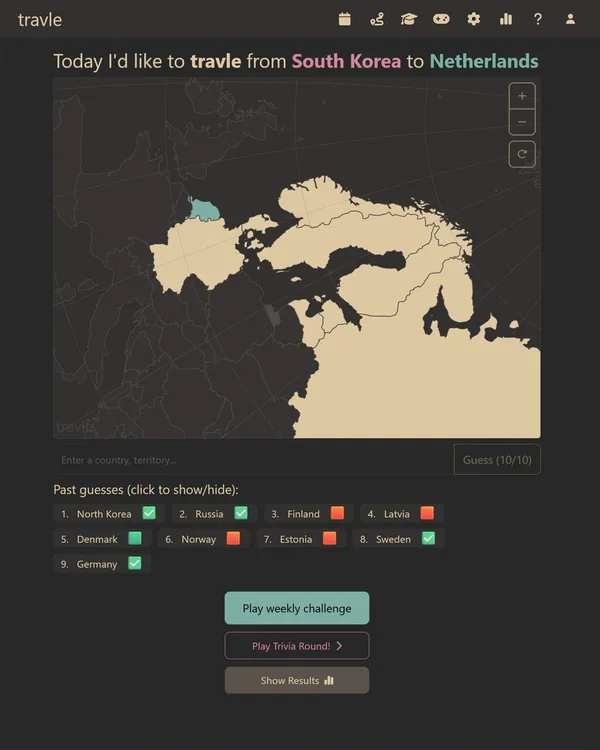
Feedback depends on the guesses already made. A green result reduces the number of additional guesses needed to finish. A check mark adds another condition: that country is connected back to the start through your earlier guesses. Orange describes a route of similar length, with the documented one-guess leeway, while red indicates a longer or impossible route through that choice. A country is not permanently green simply because it belonged to an original shortest solution.[2]
For a perfect result, the official objective is to submit a shortest route in order from the start toward the end. If your first guess branches away, reconsider the connected chain you currently have rather than continuing to type the route you imagined before seeing any feedback. A useful personal check is to point to the connection between each consecutive country before submitting the next one.
A practical strategy for the daily route
Start by identifying the broad corridor: which regions lie between the two endpoints, and which narrow crossings control access? Then work through actual neighbors. A familiar large country is a useful guess only when it connects the journey. Before committing, inspect possible bottlenecks around seas, narrow isthmuses and countries with detached areas. This turns vague map recognition into a sequence of testable connections.
When several routes appear plausible, keep the alternatives in mind without spending guesses on all of them. Look for the choice that both attaches to your current chain and leaves a short continuation. After the result, review one failed connection. Learning why an exclave or bridge behaves differently is more transferable than memorizing a single day’s finished route.
Daily Travle, practice and archive access
The current official menu separates Daily, Practice & Challenge and a weekly challenge. Its published instructions announce a new daily puzzle at midnight, but do not provide a timezone in that sentence. Use the game’s own countdown when comparing a puzzle with someone elsewhere. Practice is the appropriate starting point when you want another route after finishing the daily challenge.[1]
The current interface advertises archive access and replay as premium membership benefits. An older paragraph on the detailed information page still says the daily can only be played on its original day; that paragraph does not reflect the archive offer now shown in the live menu. Check the publisher’s current membership screen for paid access rather than assuming the entire historical archive is free.[1][2]
Play on a phone and share a route without spoilers
The official FAQ describes adding Travle to an Android or iOS home screen through the browser. The map and connections remain the game: an app-store product with a similar name should not be assumed to be the same publisher. For a daily comparison, share the puzzle identifier and result after both players finish, and leave the country sequence out of an unfinished group’s conversation.[2]
Travle FAQ
Is Travle the same as a country guessing game?
Travle asks you to connect a start and destination through countries or regions. The task is to build a continuous route rather than identify one mystery country.[2]
How many guesses do you get in Travle?
The allowance depends on the shortest solution. The official table adds more spare guesses to longer puzzles; a six-guess shortest solution receives eleven total attempts.[2]
Can I play old Travle puzzles?
The current official interface offers an archive as a premium membership feature and also lists Practice & Challenge for additional play. Check current access terms with Teuteuf.[1]
Who made Travle?
The official information page credits Oisín Carroll and identifies Travle as a Teuteuf game.[2]
Sources & verification
Checked · Daily Games editorial desk
- Travle — official game, published instructions and current modes travle.earth
- Travle 2.0 — official connections, scoring and detailed FAQ travle.earth
Rules and access notes use the sources linked above. Examples and strategy suggestions are our editorial explanations, not guaranteed solutions. Original games can change. How we research guides.
Did this guide help?
Help us keep Travle useful and accurate.