THE WORLDLE GUIDE
A shape starts the puzzle. Distance and direction help you place the next guess.
In this guide
Worldle at a glance
What is Worldle?
Worldle is Teuteuf Games’ free daily silhouette puzzle, originally created by Antoine Teuf. Identify a country or territory in six attempts.[1]
Our view is that the puzzle is strongest when you combine recognition with location. A shape can suggest several possibilities, while the feedback tests where those possibilities sit on Earth. Treat the outline as evidence you return to, not something to discard after your first guess.
How to play Worldle
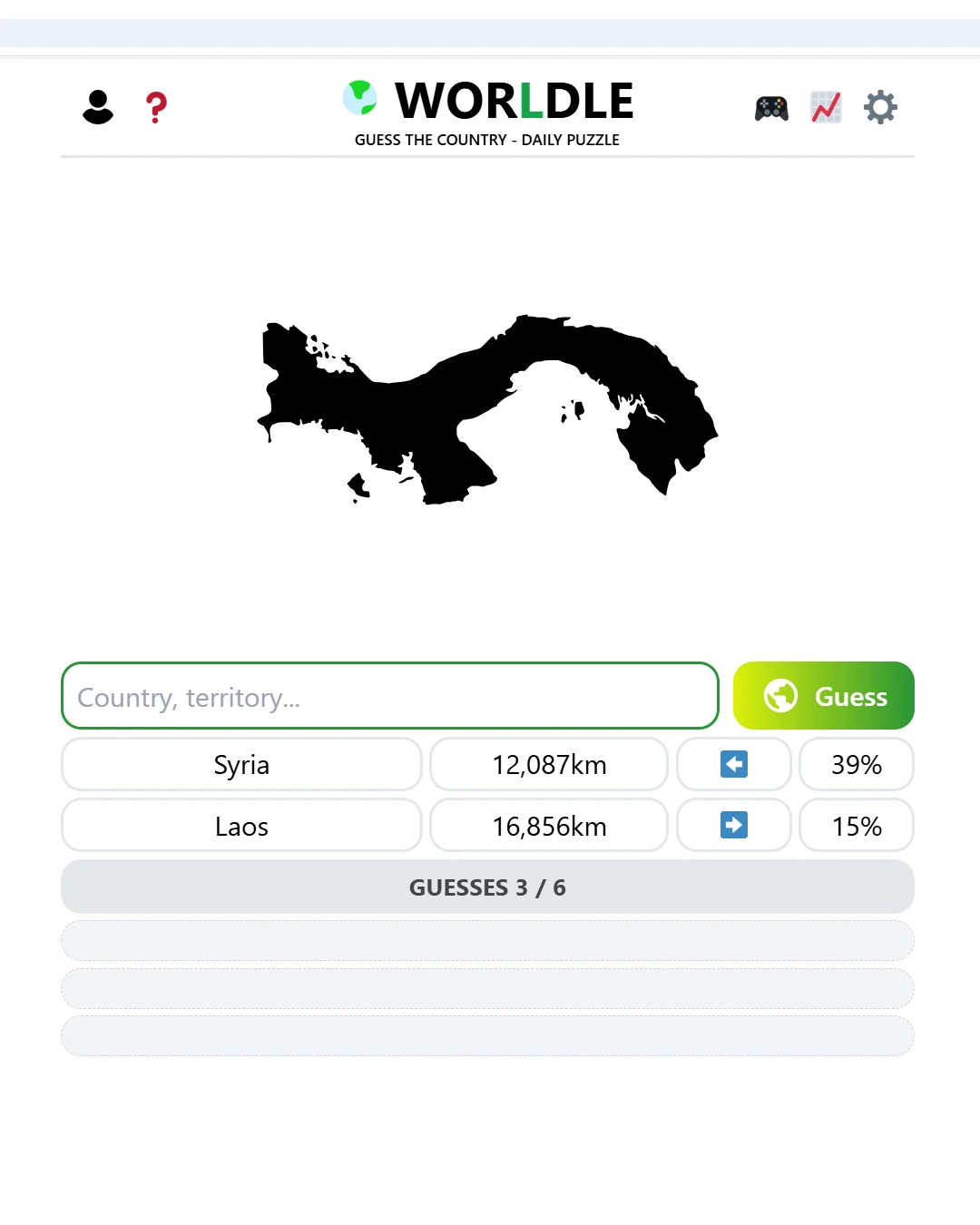
Select a country or territory from the outline. Feedback shows distance, direction and a proximity percentage; 100% is correct.[1]
For your first inspection, describe the shape without naming it. Note a long peninsula, a large indentation, a detached island, or a narrow neck. Then ask which candidate explains the combination. This editorial method helps you avoid committing to a country simply because one edge looks familiar.
Read Worldle’s distance and direction together
Distance is measured between country centers rather than borders. Arrows approximate direction using eight symbols, so neighboring countries can still be far apart by this measure.[1]
Imagine a practice result showing that the target lies roughly east and remains far away. That does not mean “guess the next country to the east.” It means your next candidate should be compatible with both the direction and the scale of the distance. This is an invented interpretation exercise, not a clue to today’s answer.[1]
Our suggested check after every submission is: what did this eliminate, and which remaining shapes still fit? If a second guess gets farther away, compare it with the first before continuing. The two measurements together can be more informative than either one in isolation.
Worldle strategy: change your scale assumptions
A useful editorial habit is to reconsider size. A compact silhouette on screen might represent a large country or a tiny territory. If the same shape keeps leading to implausible guesses, change your mental scale before inventing an increasingly elaborate explanation for the wrong continent.
Keep a short candidate list and test its geometry. If you are choosing between a mainland country and an island, look for detached pieces and the shape of the coast. If two candidates share a long north–south outline, compare their widest point and the location of any bend.
After solving, make one durable association: a distinctive notch, a neighboring region, or the position of a capital. Avoid trying to memorize every detail at once. A small, specific observation gives you something concrete to recognize the next time a similar outline appears.
Worldle reset, bonus rounds and archive access
The daily resets at local midnight. Bonus rounds include neighbors, capital and flag. The archive requires a Teuteuf account and Premium Membership.[1]
For a friendly competition, compare the main six-guess result separately from any bonus questions. For practice, pick one skill to improve: recognizing outlines, locating countries relative to a guess, or recalling borders. This keeps extra play focused instead of turning every round into the same vague geography test.
Worldle FAQ
Why is a neighboring country still far away?
Distances use country centers, not closest borders.[1]
When does Worldle reset?
Midnight in your device’s local time zone.[1]
Is the Worldle archive free?
No. The official FAQ specifies an account and Premium Membership.[1]
What is the difference between Worldle and Wordle?
Worldle identifies countries and territories from silhouettes and geography clues.[1]
Sources & verification
Checked · Daily Games editorial desk
- Worldle: official daily game, rules and FAQ worldle.teuteuf.fr
Rules and access notes use the sources linked above. Examples and strategy suggestions are our editorial explanations, not guaranteed solutions. Original games can change. How we research guides.
Did this guide help?
Help us keep Worldle useful and accurate.